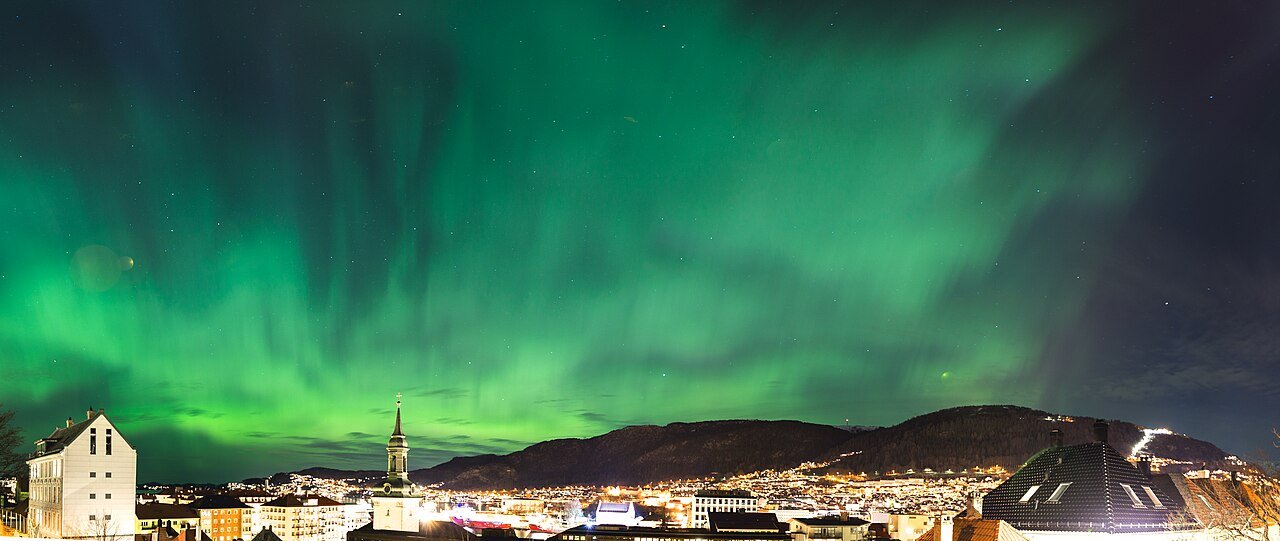
Tromsø is the world's most visited northern lights destination. Every winter, tens of thousands of people fly in hoping to see the aurora borealis, and most of them book a three-night trip, spend two of those nights under cloud cover, and leave disappointed. This guide is written to prevent that.
What follows is not a list of pretty hotels and generic tips. It is a practical breakdown of how to plan a Tromsø northern lights trip that actually works — based on how the weather behaves, when to go, what the tours actually deliver, and when self-driving beats paying €120 per night for an organised experience.
Why Tromsø for Northern Lights?
Tromsø sits at 69.6°N — well inside the auroral oval, the band around the magnetic pole where the Northern Lights are most active. It has a major airport with direct connections from London, Amsterdam, Frankfurt, and Oslo, making it the most accessible Arctic city in Norway.
The city has built an entire economy around aurora tourism. There are more tour operators, specialist guides, and aurora-focused experiences here than anywhere else in the world. If you want maximum choice and maximum convenience, Tromsø delivers.
The drawback is the weather. Tromsø is a coastal city, and coastal Norwegian weather is maritime — meaning cloud cover is frequent, persistent, and moves unpredictably. On any given winter night, there is roughly a 50% chance of useful cloud cover. That sounds manageable until you are on night three of a four-night trip and the sky has not cleared once.
Best Time to Visit Tromsø for Northern Lights
The aurora season in Tromsø runs from late September to late March — any time the nights are long enough for the sky to go properly dark. But within this window, some periods are clearly better than others.
February and March: the best months
February and March consistently produce the best results in Tromsø for two reasons. First, the auroral equinox effect: geomagnetic activity measurably increases in the weeks around both equinoxes (late March and late September), meaning more active aurora events. Second, by February the worst of the polar night weather has often stabilised, and you get some daylight hours to actually enjoy the landscape between aurora hunts.
March adds a third advantage: daytime temperatures are still well below zero and the landscape is fully winter, but the days are long enough (4-6 hours of light) to do dog sledding, snowmobile tours, or fjord excursions during daylight and then aurora-hunt at night.
December and January: polar night, but expensive and cloudy
The polar night period — when the sun does not rise at all — runs from roughly 27 November to 15 January in Tromsø. It sounds dramatic, and it is, but it does not produce better aurora displays than February. What it does produce is higher hotel prices, more cloud cover, and colder temperatures.
If your main goal is to see the northern lights (rather than experience polar night specifically), December and January are not the optimal months. Go in February or March.
October and November: underrated
October and early November are genuinely underrated for Tromsø. The nights are long, the landscape is transitioning to winter, there is occasional autumn colour at lower elevations, and prices have not hit peak-season levels. Geomagnetic activity can be strong around the September equinox, carrying into October. The downside is that snow is unreliable at this time — the iconic white landscape backdrop for aurora photos is not guaranteed.
How Long to Stay
This is where most trips fail. A three-night stay in Tromsø gives you three shots at a clear sky with aurora activity. Given the roughly 50% cloud-cover probability per night, statistically you have about a 12% chance of all three nights being clouded out — which sounds acceptable until it happens to you.
The recommended minimum is 5 nights. At five nights, you need four consecutive cloudy nights to completely miss aurora, which is statistically unlikely even in a coastal location. Most dedicated aurora hunters book 6-7 nights and accept that one or two blank nights is normal.
If you can only manage 3-4 nights, the risk mitigation strategy is to book a guided chase tour every available night. Chase tour operators monitor weather across a 300km radius and drive you to wherever the sky is clear. This dramatically reduces the risk of a wasted night compared to standing in Tromsø city waiting for local clouds to move.
Aurora Tours in Tromsø: What to Expect
Tromsø has dozens of aurora tour operators. The core product is similar across most of them: a minibus with a guide, a drive of 50-200km to find clear skies, 2-3 hours in the field watching (and photographing) the aurora, and a warm meal or hot drinks at a camp. Cost: €85-130 per person.
What the tour does well
The guide monitors aurora forecasts and cloud cover in real time and makes the call on where to go. On a night when the aurora is active but clouds are covering Tromsø, a good guide can drive you into a clear-sky window 80-150km away. This mobility is the single biggest advantage of booking a guided tour: you are not stuck waiting in one location.
What it does not do well
You are in a group of 8-16 people. The group moves at the same pace, stops at the same locations, and has limited time at each spot. For photographers who want to compose a specific shot or move between multiple locations in one night, a group tour is frustrating. The camps used for the meal/hot drinks portion are often the same locations used by multiple operators — on a busy night, you share the landscape with 50-100 other tourists.
Photography-focused tours
Several operators offer smaller, photography-specific tours (4-6 people maximum) with a guide who understands camera settings and compositions. These cost more — €150-250 per person — but the difference in both experience and results is significant. If photography is the reason you are making this trip, this is worth the premium.
Self-Drive Aurora Hunting from Tromsø
Tromsø is one of the best cities in Norway for self-drive aurora hunting because of its location. The E8 and E6 roads provide access to the Lyngen Alps, the Ullsfjord, and the plateau areas east of the city within 60-90 minutes of driving — and these areas often have clearer skies than the city itself.
Winter car rental in Tromsø
Renting a car in Tromsø in winter requires attention to one detail: studded tires (piggdekk) are mandatory on Norwegian roads between November and the first Sunday after Easter. Most major rental companies at Tromsø Airport include winter tires as standard, but confirm this explicitly when booking — "all-season" tires are not sufficient and will fail on compacted snow and ice.
A compact car (VW Golf, Toyota Corolla class) with winter tires costs approximately €60-90 per day from Tromsø Airport. For 5-7 nights, this totals €300-630 — comparable to booking 4-5 guided tours, but giving you unlimited mobility every night.
Best self-drive routes from Tromsø
- E8 towards Nordkjosbotn: Drive 45 minutes southeast. The road moves inland and often exits coastal cloud banks. The Balsfjord area offers dark skies and reflective water.
- E6 north towards Nordkjosbotn then Øverbygd: More inland terrain, higher elevation, generally clearer.
- Svensby / Lyngen ferry: Cross by ferry to the Lyngen peninsula for dramatic mountain backdrops behind the aurora.
- E8 towards Finland: The Skibotn Valley, 90 minutes from Tromsø, sits in a meteorological rain shadow and has some of the most reliable clear-sky conditions in the region.
The key tool for self-drive aurora hunting: the Norwegian Meteorological Institute's yr.no for hour-by-hour cloud cover forecasts, and SpaceWeatherLive.com for Kp index real-time data. Check both before leaving the hotel and have a direction in mind before you start driving.
Daytime Activities in Tromsø in Winter
Tromsø offers more winter daytime activities than any other Arctic city. During polar night, these happen in near-darkness or the blue twilight of late morning. From February onwards, you get 2-6 hours of actual daylight.
- Dog sledding: Multiple operators offer 2-3 hour husky tours from kennels 20-40km outside the city. Cost: €150-250 per person. One of the most popular daytime Arctic experiences in Tromsø.
- Reindeer sleigh rides: Sami-run experiences where you ride a reindeer sleigh and learn about traditional Sami reindeer herding culture. Cost: €80-150 per person.
- Snowmobile safaris: Guided snowmobile tours across the plateau behind Tromsø. No licence required if on a guided tour. Cost: €150-300 per person depending on duration.
- Whale watching (November-January): Orcas and humpback whales follow herring into the fjords near Tromsø in winter. Boat tours depart from the city harbour. Cost: €100-150 per person.
- Tromsø city: The Arctic Cathedral (Ishavskatedralen), the Polaria museum, the cable car (Fjellheisen) up to the plateau — all worthwhile for a few hours between sleep and the evening aurora hunt.
Getting to Tromsø
Tromsø Airport (TOS) has direct international connections from London Gatwick (Norwegian), Amsterdam (KLM), and Frankfurt (Lufthansa), plus frequent domestic connections from Oslo (SAS, Norwegian, Widerøe). Flying time from London: approximately 3 hours. From Oslo: 2 hours.
The airport is on an island 5km from the city centre. Airport buses (Flybussen) run every 15-20 minutes to the city and cost approximately NOK 100 (€9). Taxis cost NOK 250-350 (€22-30) for the same journey.
Where to Stay in Tromsø for Northern Lights
The most practical base for aurora hunting is the city centre. Tour operators pick up from city centre hotels, and having a central location means you can return quickly if the aurora activates unexpectedly at 11pm.
Tromsø accommodation ranges from budget hostels (€40-60/night) to mid-range hotels (€100-180/night) to high-end design hotels (€200-350/night). In peak season (December-February), book at least 2-3 months in advance — the city fills up fast.
If you are self-driving and want to be closer to the clearest-sky corridors, consider staying in Skibotn (90 minutes from Tromsø, in the Lyngen Alps valley) or Nordkjosbotn (45 minutes east). Both have guesthouses and consistently better weather than Tromsø city.
Tromsø vs Alta: Which Should You Choose?
This is a real question worth answering directly. Alta has statistically more clear nights per winter than Tromsø because it sits further inland and is less exposed to Atlantic weather systems. The Northern Lights Cathedral in Alta was not built there as a tourist gimmick — it was built there because scientists and architects have long recognised Alta as having exceptional aurora conditions.
Choose Tromsø if: you want maximum tour operator choice, you are flying from a destination with direct Tromsø connections, or this is your first Arctic trip and you want the full infrastructure.
Choose Alta if: you have already been to Tromsø, you are prioritising clear skies over convenience, or you want a less touristed experience with comparable (or better) aurora opportunities.
Frequently Asked Questions
How strong does the aurora need to be to see it in Tromsø?
A Kp index of 1-2 is sufficient for visible aurora on a clear night in Tromsø. You do not need a major geomagnetic storm — the city's latitude means even low-level activity produces displays. What you do need is a clear sky.
What time of night is best for northern lights in Tromsø?
Aurora activity peaks statistically around local magnetic midnight — approximately 23:00-01:00 in Tromsø. However, aurora can appear from dusk to dawn and has no fixed schedule. Tour operators typically run from 18:00-23:00 or 21:00-02:00. If you are self-driving, plan to be in the field from at least 21:00 to midnight.
Is Tromsø safe for solo travellers?
Yes. Tromsø is a Norwegian city with extremely low crime rates. Solo travellers — including solo women — report feeling completely safe both in the city and on guided aurora tours. The city centre is compact and walkable.
Can you see northern lights in Tromsø in summer?
No. From late April to mid-August, the midnight sun means the sky never gets dark enough to see aurora. The aurora is still there — the sky is simply too bright to see it. Aurora season in Tromsø runs exclusively from late September to late March.