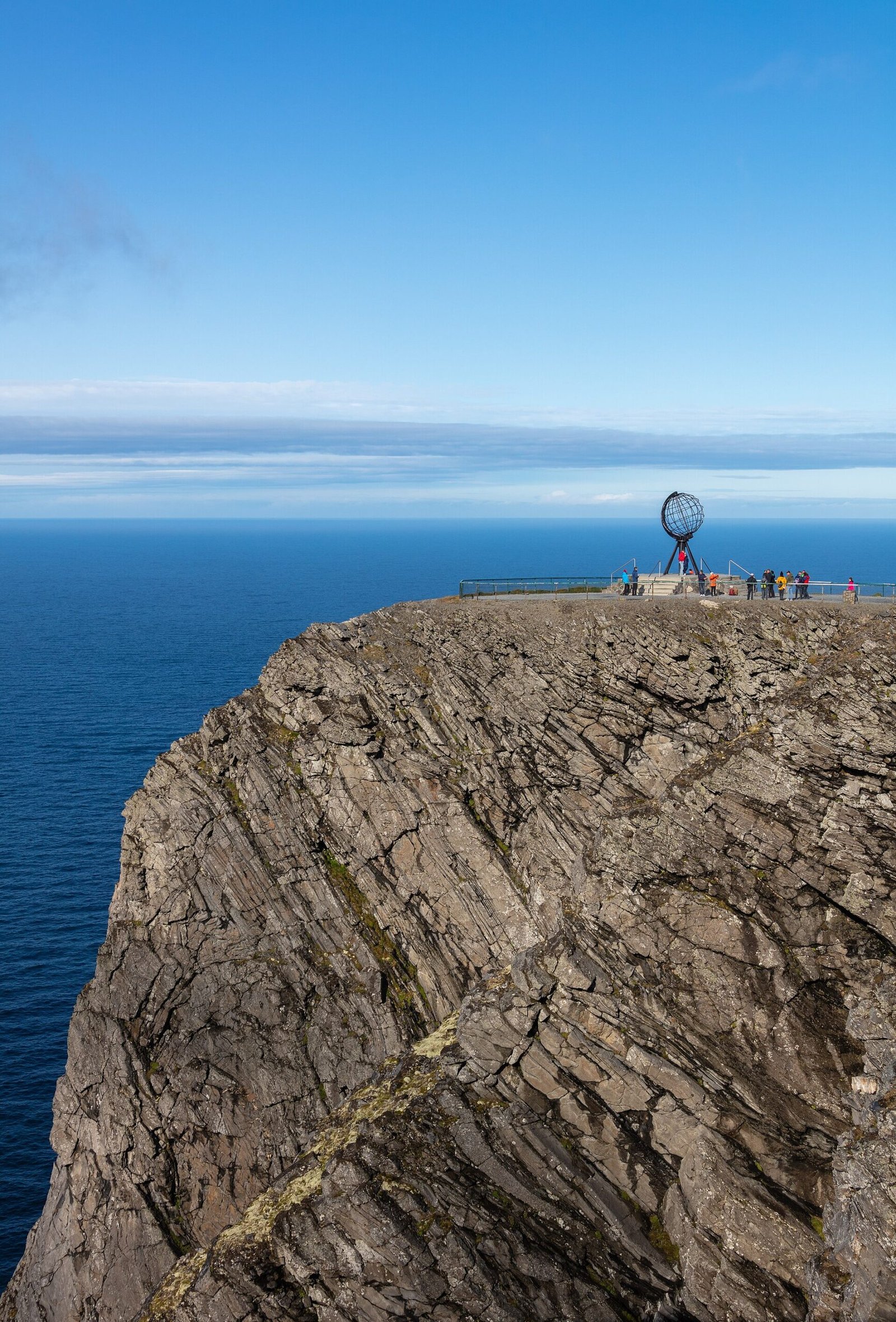
The North Cape (Nordkapp) is the northernmost point in mainland Europe accessible by road. At 71°10'21"N, it is a cliff standing 307 metres above the Arctic Ocean — and in winter, getting there requires navigating one of the most demanding road journeys in Norway.
Most travellers pass through Hammerfest on the way to Nordkapp — our Hammerfest guide.
This guide covers the North Cape in winter specifically. Summer is straightforward: drive the E69, park, look at the globe sculpture, leave. Winter is different. The E69 closes frequently, convoys are mandatory, the road conditions are genuinely dangerous for unprepared drivers, and the experience — when it works — is something summer tourists never get to see.
Can You Visit the North Cape in Winter?
Yes — but conditionally. The North Cape Visitor Centre (Nordkapphallen) is open year-round, and the E69 road from Honningsvåg stays open through winter when conditions allow. The critical word is "when." Between October and April, the E69 is regularly closed due to extreme weather, and when it reopens, it reopens under a convoy system (Kolonnekjøring) that requires all vehicles to drive in a supervised group behind a snowplough.
The convoy system is not a deterrent — it is actually what makes winter driving to the North Cape possible. Without it, the road would simply be closed for months. But it does mean your visit is not on your own schedule.
The E69: Norway's Most Dramatic Winter Road
The E69 is a 68km road connecting Olderfjord (on the E6) to the North Cape plateau. The final section, from Honningsvåg to the plateau, climbs steeply and is completely exposed to Arctic winds and drifting snow. In heavy weather, visibility can drop to near zero within minutes.
The Norwegian Public Roads Administration (Statens Vegvesen) monitors conditions continuously and makes real-time decisions about whether to open, convoy, or close the road. You can check the current status at vegvesen.no (select the E69 in Finnmark).
Convoy schedules
When the road is open but conditions require convoy, vehicles gather at a designated assembly point and depart at scheduled times — typically twice daily, morning and afternoon, though exact schedules vary by conditions and season. A snowplough leads the convoy, and all vehicles maintain convoy discipline (no overtaking, required following distance).
Waiting times for a convoy can be 2-6 hours if you arrive between scheduled departures. Plan for this. Do not show up expecting to drive straight through.
Vehicle Requirements for the North Cape in Winter
Before allowing your vehicle into a convoy, the police or road authority may inspect it. Vehicles that do not meet winter requirements are turned away.
Mandatory
- Studded tires (piggdekk): Compulsory in winter conditions. "All-season" tires are not accepted. Most rental companies in Finnmark include studded tires as standard — confirm before booking.
- Functioning heating system: Your car must be able to maintain interior temperature. A heater failure on the plateau in -20°C is life-threatening.
Strongly recommended
- Snow shovel: To dig your exhaust pipe clear if the car gets buried during a convoy wait or breakdown.
- Wool blankets or sleeping bag: The engine must be switched off during extended convoy waits to prevent carbon monoxide buildup. The interior cools rapidly.
- Extra fuel: There are no petrol stations on the E69 plateau. Fill up in Honningsvåg before attempting the Cape.
- Emergency food and water: A 24-hour supply in case of an extended delay or road closure while on the plateau.
- Jump leads: Cold temperatures drain batteries. If someone else's car fails in the convoy, being able to help also keeps things moving.
The North Cape in Winter: What You Actually See
Summer visitors see the globe sculpture, a flat plateau, and the Arctic Ocean. Winter visitors see something categorically different.
In deep winter (December-January), the plateau is under polar night — the sun does not rise. The landscape is a white and blue expanse lit only by moonlight, stars, and occasionally the northern lights. The visitor centre windows face north, directly towards the auroral oval. On active nights, the aurora can fill the entire view from inside the building.
The cliff at the Cape drops 307 metres to the Arctic Ocean. In winter, the sea below is partly frozen at its edges, and the sound and visual scale of the place — in darkness, with wind off the ice — is genuinely imposing in a way that no photograph reproduces accurately.
Northern lights at the North Cape
The North Cape plateau is one of the few places in the world where you can watch the northern lights from the edge of a cliff over the open Arctic Ocean. There is no light pollution for hundreds of kilometres north. On a clear night with aurora activity, this is as close to a perfect aurora viewing location as exists on Earth.
The downside: the plateau is fully exposed to Arctic wind. Temperatures of -15°C with a wind chill of -30°C or colder are common. Time outside is limited to however long your gear allows — for most people without expedition-grade equipment, 20-30 minutes of meaningful time outside before cold becomes a real concern.
North Cape Visitor Centre (Nordkapphallen)
The visitor centre is open year-round and is a full facility: restaurant, café, exhibition spaces, a panoramic viewing hall, a cinema (showing a 20-minute film on the history and nature of the Cape), souvenir shops, and a chapel. Entry costs approximately NOK 295 (€26) per adult.
The building is warm, the restaurant serves hot food (including traditional reindeer stew), and crucially, it provides shelter during convoy waits or weather holds. If you are forced to wait 3 hours for the next convoy departure, being able to sit inside with a meal makes the difference between an ordeal and an experience.
How to Get to the North Cape
By car from Honningsvåg
Honningsvåg is the last town before the Cape, 35km away via the E69. It has petrol stations, a supermarket, accommodation, and a harbour. Fill your tank here. The nearest airport is Honningsvåg Airport (HVG), with connections to Tromsø via Widerøe.
By car from Alta
Alta to the North Cape is approximately 240km via the E6 and E69, taking 3-4 hours in good conditions. In winter, add time for convoy waits. Alta is the most practical base for a North Cape day trip that also includes other Finnmark activities. Most people who drive the E69 in winter start from Alta or Honningsvåg.
By bus (Hurtigruten + local connection)
The Hurtigruten coastal ferry calls at Honningsvåg year-round, and the cruise line offers organised North Cape tours from the ship. This is primarily a summer offering — in winter, the logistics of convoy schedules and tour timing are more difficult to coordinate.
Organised tours from Alta and Honningsvåg
Several operators in Alta and Honningsvåg offer guided North Cape tours that handle convoy timing and logistics. These are particularly useful for travellers who do not want to drive themselves in Arctic winter conditions. Prices vary: €80-150 per person for a day trip from Honningsvåg, €200-350 from Alta.
North Cape in Summer vs Winter
Summer (June-August) brings the midnight sun and accessible roads with no convoy requirements. It is the most popular time to visit, which means crowded car parks, queues at the globe, and a visitor centre at capacity. The light is extraordinary — standing at the cliff edge at midnight in full daylight — but the experience feels closer to a tourist attraction than a wilderness encounter.
Winter is harder to get to, requires preparation, and offers no guarantees. But when it works — convoy completed, plateau reached, aurora active over the cliff edge — it is a genuinely rare experience. The empty plateau in polar night silence is a different place from the summer version entirely.
Frequently Asked Questions
Is the North Cape the actual northernmost point of Europe?
Technically, no. The actual northernmost point of the European mainland is Knivskjelodden, a cape on the same island (Magerøya), reachable only by an 18km round-trip hike across Arctic terrain. The North Cape (Nordkapp) is the northernmost point accessible by road. The distinction matters to geography purists; for everyone else, the North Cape is the destination.
How long does the convoy take?
The convoy from the assembly point to the North Cape plateau takes approximately 45-60 minutes, depending on weather conditions and the speed of the snowplough. The total time at the Cape before the return convoy is usually 2-3 hours.
Can the North Cape be visited in a day from Tromsø?
By car, it is technically possible but not recommended. Tromsø to North Cape is approximately 600km and takes 7-8 hours each way in good summer conditions — longer in winter. In winter, with potential convoy waits, this is a two-day minimum journey. Most people use Alta or Honningsvåg as the base for a North Cape visit.
What is the temperature at the North Cape in winter?
The plateau at the North Cape sits 307m above sea level and is fully exposed. Average temperatures in December-February range from -8°C to -18°C, with wind chill regularly pushing the felt temperature to -25°C or colder. Dress for the extreme end of this range, not the average.