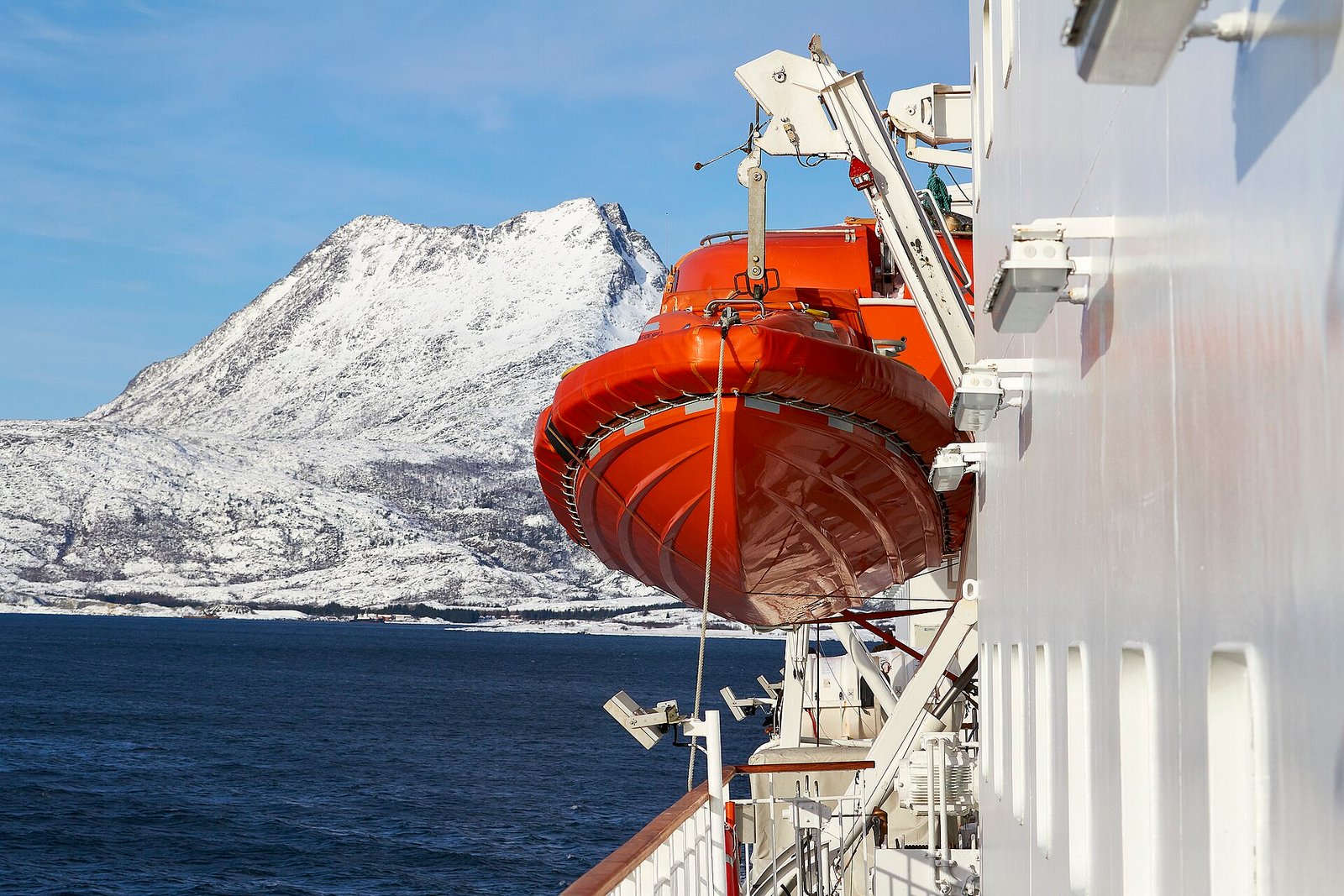
Seeing the northern lights from the water is a different experience from any land-based viewing. The sea provides a dark, unobstructed horizon, the reflections on a calm fjord double the visual impact, and the combination of cold salt air and green lights overhead is genuinely hard to forget. Norway has multiple ways to do this — not all of them involve Hurtigruten.
Option 1: Hurtigruten Coastal Ferry
The most famous option. Hurtigruten runs the Bergen–Kirkenes coastal route year-round, stopping at 34 ports over 12 days. In winter, the ship travels through prime northern lights territory every night. Our full Hurtigruten review covers whether it lives up to the expectation — the short version: aurora sightings are real but not guaranteed, and the experience is more about the coastal voyage than a dedicated aurora hunt.
Cost: a winter cabin on the Bergen–Tromsø segment (3–4 days) starts around €600–900 per person. Full Bergen–Kirkenes round trip is €1,500–3,000+ depending on cabin class. Hurtigruten also runs a dedicated 7-day winter aurora cruise (Tromsø–Tromsø) from September to January at approximately €1,200–2,000 per person, which focuses more on aurora-chasing than the standard full-length coastal route.
The advantage of Hurtigruten is comfort, predictability, and the ability to combine aurora viewing with daytime activities like visiting North Cape, exploring Hammerfest, or kayaking in Raftsund. The disadvantage is that you're on a set schedule with 400–700 passengers, which limits the ship's ability to chase clear skies actively. Aurora visibility from a large coastal ferry is also often from the upper decks in cold wind, rather than the more intimate viewing experience of smaller boats.
Option 2: Dedicated Aurora Expedition Ships
Several small expedition companies run purpose-built aurora cruises in Norwegian fjords, typically from Tromsø. These ships carry 12–40 passengers and can anchor in remote fjords away from light pollution, waiting for clear skies. Unlike Hurtigruten, they specifically follow weather patterns to maximise sighting chances. Operators include Basecamp Explorer (runs the 40-passenger Basecamp Nordica with 5–7 night voyages) and Aurora Expedition from Tromsø harbour, which typically uses smaller vessels of 15–20 capacity.
Cost: €250–400 per person for a single-night expedition. Multi-night packages from €800–1,500. Basecamp Explorer's 7-night aurora expedition runs approximately €2,500–3,500 per person all-inclusive, including meals, thermal suits, and guides.
These vessels are significantly more agile than Hurtigruten. A skipper can relocate within 30–60 minutes if weather clears in a different fjord, and the smaller group size means better aurora photography opportunities and more personalised guide interaction. Most include onboard accommodation, hot food, and instruction on aurora photography. The trade-off is less creature comfort than larger ships — cabins are compact and facilities are basic.
Option 3: RIB Boat Aurora Tours
The most intense option. Open rigid inflatable boats take small groups (6–8 people) into Tromsø's outer fjords at speed. Cold, exposed, and spectacular. Tours typically run 3–4 hours and include thermal suits. Multiple operators in Tromsø offer this from October to March. The RIB's speed means guides can chase clear patches aggressively. Notable operators include Tromsø RIB Tours and Arctic Cruises Tromsø.
Cost: €130–180 per person. Best for people who want an active, adrenaline-tinged experience rather than a comfortable viewing platform.
RIB tours reach remote fjords between Tromsø and the North, often positioning at locations 15–25 km from town. The boat moves constantly, which keeps you warm and allows the guide to pivot toward clear patches quickly. However, the speed and exposure mean this isn't suitable for people prone to seasickness or cold sensitivity, even with thermal suits provided. Tours operate in near-total darkness October–January, so expect genuine Arctic conditions.
Option 4: Traditional Wooden Boat Tours
Several Tromsø operators run aurora tours on traditional Norwegian wooden vessels — slower, warmer, and more atmospheric than RIBs. These tours typically include hot drinks and food on deck, and the boat anchors in sheltered positions with good northern horizons. The pace is calm and social. Operators like Polarcus and Tromsø Boat Tours offer evening cruises typically 3–5 hours long.
Cost: €120–160 per person. Good for couples and groups who want a romantic rather than adventurous experience.
Wooden boat tours work well for first-time aurora visitors who want to combine comfort with water-based viewing. Most boats have an indoor cabin with large windows and heated seating, plus an open deck for unobstructed viewing and photography. Hot chocolate, soup, or traditional Arctic food is usually provided. Because these boats anchor rather than cruise at speed, they're better for patience-based aurora watching — you position and wait for activity, rather than chasing it.
Option 5: Self-Chartered Boat
For groups of 4–8, chartering a small boat with a skipper is surprisingly affordable and gives you maximum flexibility — the skipper can go wherever conditions are best. Available from Tromsø and Alta. Requires advance planning and a minimum group size. Companies like Tromsø Boat Rental and Arctic Maritime Services offer skippers experienced in aurora positioning.
Cost: €150–250 per person for a 4-hour charter with a group of 6. A full 8-hour evening charter for 6 people typically runs €800–1,200 total, or about €130–200 per person.
Self-chartered boats are ideal if your group has specific interests — you can request a boat that accommodates photography equipment, has good cabin heating, or positions near specific locations. You also have complete control over timing and route. The downside is logistics: you'll need to coordinate pickup, brief your skipper on conditions, and handle all details yourself rather than booking a packaged tour.
Seasonal Timing and Weather Conditions
Aurora visibility from boats depends heavily on geomagnetic activity and cloud cover, regardless of which option you choose. The viewing season runs September to March, with peak probability November to January. December has good aurora frequency but also heavy cloud cover in many years; October and February offer clearer skies statistically, though fewer daylight hours mean shorter tours possible in December.
Sea conditions matter significantly. The outer fjords and open waters around Tromsø can be rough September–March, which affects both comfort and visibility. Most operators monitor weather closely and cancel or reschedule tours when conditions become unsafe. Water temperature stays between 0–4°C year-round, and ice is not typically a hazard on commercial routes, though operators reserve the right to adjust positioning if unexpected ice forms.
Which Option Is Best?
For the highest chance of seeing aurora on a dedicated trip: expedition ships or RIB tours from Tromsø, which actively chase conditions. For a broader travel experience that includes aurora as one element: Hurtigruten. For budget-conscious travellers doing land-based multi-night aurora trips, the boat tours are excellent as a one-evening experience alongside self-drive. Traditional wooden boat tours work best for people combining romance, comfort, and water-based viewing without the intensity of a RIB.
If you have limited time (1–2 days) and are in Tromsø, a single-night RIB or wooden boat tour is efficient. If you have 4+ days, pairing land-based viewing (hotel, cabin, or glass igloo) with one boat tour gives you backup options if one night has cloud cover. If you want a complete voyage experience and don't mind a larger crowd, Hurtigruten's dedicated winter aurora cruise offers comfort and route variety.
What to Know Before You Book
- Aurora is never guaranteed. Even the most aggressive tour operators cannot control geomagnetic activity or cloud cover. Reputable operators offer rebooking discounts or refunds if auroras don't appear.
- Layering is essential. Thermal suits are provided on RIB tours, but bring warm base layers, wool socks, and a windproof jacket regardless. Boat wind chill is colder than land-based viewing.
- Photography equipment needs protection. Bring extra batteries (cold drains them quickly) and waterproof protection. Many tour operators are experienced with photographer needs and can position near railings with stable views.
- Seasickness medication helps. Even calm fjords can produce gentle swell. Take medication before departure if you're prone to motion sickness, especially on RIBs.
- Book 1–2 weeks in advance for better availability. Peak season (December–January) can book out 3+ weeks ahead for small expedition ships.
Frequently Asked Questions
What's the difference in aurora-sighting probability between boat tours and land-based viewing?
Boat tours don't inherently have better aurora odds than land-based trips — the determining factors are geomagnetic activity, cloud cover, and dark skies. However, boats offer two practical advantages: they can reposition quickly if weather clears elsewhere, and they provide darker horizons than viewing from town (which light pollution affects). For a single evening, a land-based trip to a remote lodge or cabin likely gives equal odds at lower cost. Boats are better if you want flexibility to chase conditions across multiple nights or if you're already on the coast.
Which boat tour is best for aurora photography?
Small expedition ships (Basecamp, Aurora Expedition) offer the most stable shooting platforms and smallest group sizes, which means less light pollution from other passengers and more time to focus on composition. RIB boats are challenging for serious photography due to movement and spray. Wooden boat tours with a sheltered deck and anchored position are a reasonable middle ground. If photography is your priority, consider land-based viewing instead — a tripod on solid ground is ultimately superior to shooting from a moving or rocking boat.
Is a 3-night Hurtigruten segment worth the cost compared to a dedicated 3-night expedition?
It depends on your interests. Hurtigruten offers comfort, scheduled port visits (North Cape, Hammerfest, Honningsvåg), and a sense of completing a historic voyage. A 3-night dedicated expedition offers more focused aurora hunting, smaller group experience, and direct interaction with aurora specialists. Hurtigruten costs roughly 30–40% more for equivalent cabin comfort, but you're paying for the full coastal experience, not just aurora chasing. If aurora is your only goal, dedicated expeditions offer better value. If you want a multi-day coastal voyage with aurora as part of the experience, Hurtigruten justifies the cost.
Can I do a boat tour with children?
Yes, but with caveats. Wooden boat tours are family-friendly and accommodate children typically aged 5+. RIB tours usually require age 12+ due to physical intensity and cold exposure. Hurtigruten welcomes families and offers daytime activities for children. Expedition ships vary — check operator policies. Children under 12 on any boat tour should have adult supervision and proper thermal protection. Late evening tours (10 PM–3 AM) are difficult with young children due to fatigue and sleep schedules.