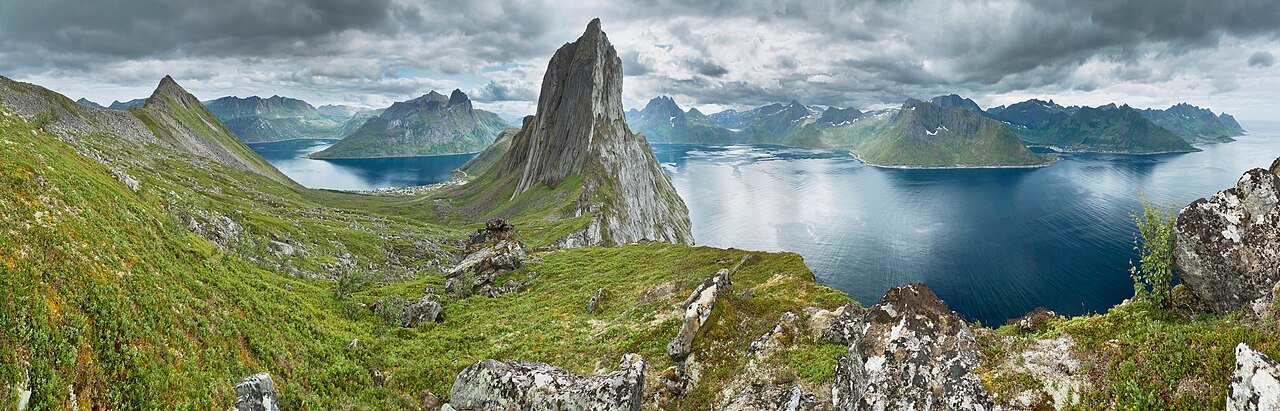
Senja is the island that Norwegian travel writers describe as 'Lofoten before the crowds'. It's Norway's second-largest island, it sits one hour south of Tromsø, and it combines the dramatic mountain-meets-fjord scenery of Lofoten with a fraction of the tourist numbers. Most visitors fly over it on the way to other places. That's a significant mistake.
Why Senja Looks the Way It Does
Senja's western coast faces the open Norwegian Sea and has been sculpted by millennia of wind and waves into a sequence of peaks, arches, and sea stacks that photographers specifically target. The eastern side is quieter — sheltered fjords, small fishing communities, flat agricultural land. The island is essentially two landscapes in one, connected by a single road that crosses the mountain spine.
The most photographed spot is Segla, a 639-metre peak that rises almost vertically from Mefjorden with a distinctive pointed summit. The hike to the top takes 2–3 hours from the trailhead and offers one of Norway's finest summit views — the entire island visible in both directions, with open sea to the west.
Northern Lights on Senja
Senja sits at 69°N — well above the Arctic Circle and directly under the northern lights oval. The island's low population density means minimal light pollution, and its mix of reflective fjords and dramatic silhouetted peaks creates some of the best aurora photography backdrops in all of Norway. The aurora season runs October through March, with the same statistics as Tromsø but with far fewer people competing for the same viewpoints.
For night photography, the Husøy peninsula and the stretch of road above Tungeneset are particularly good — open horizons to the north, fjord reflections below, and no street lighting within kilometres.
Getting to Senja
The practical base is Tromsø. From Tromsø airport, the drive to Senja takes approximately 2.5 hours via the E8 and RV86. The island is connected to the mainland by two bridges, so no ferry is needed. Senja works well as a 2-night detour on a broader Arctic Norway itinerary — leave Tromsø for Senja, spend two nights, return via a different route through the mountains.
There is no public transport worth using. A rental car is essential. Roads on the western coast are narrow and winding — drive carefully in winter conditions.
Best Things to Do on Senja
- Hike Segla peak (3–4 hrs return, bring crampons in winter)
- Drive Scenic Route 862 along the western coast
- Visit Tungeneset — dramatic sea arch with views of Okshornan peaks
- Aurora photography at Husøy harbour (photography guide)
- Kayaking in Mefjorden (summer and autumn only)
- Eat at Hamn i Senja — the island's best restaurant in a historic fishing harbour
Where to Stay
Accommodation on Senja is limited but characterful. Hamn i Senja offers rorbuer (traditional fishing cabins) right on the water. Skaland camping has simple cabins year-round. Book ahead in summer; winter is more flexible. For more options and the full infrastructure of a city, base yourself in Tromsø and do Senja as a day trip or overnight.
Senja vs Lofoten
Lofoten (winter guide) has more developed tourism, more accommodation variety, and is slightly easier to access. Senja has wilder scenery on its western coast, fewer tourists, and a more authentic feel. If you've done Lofoten and want something rawer, Senja is the clear next step. If it's your only Norwegian island, Lofoten wins on infrastructure.